
People do not follow titles for long. They follow credibility. They follow consistency. They follow leaders whose behavior makes trust possible. In an age when culture is tested daily, the enduring leadership principle is surprisingly simple: do your job, live your values, and give people something worth following.

There is a leadership lesson that never goes out of date: people watch the leader.
They watch how we enter a room, how we handle pressure, how we respond to setbacks, and how we treat people when the spotlight is off. They listen to what we say, of course, but they believe what we repeatedly do. Long before people fully buy into a vision, they decide whether they trust the person carrying it. That is why leadership is never built on words alone. It is built on credibility. It is built on consistency. It is built when our walk matches our talk.
This truth feels especially timely in today’s business environment. Teams are moving fast. Expectations are rising. Communication is constant. Yet for all the meetings, messaging, and strategy sessions in the modern workplace, one of the greatest leadership needs is still clarity. People are not starving for slogans. They are starving for leaders they can believe.
That is why one of the strongest and simplest leadership standards is also one of the oldest: Do your job.
At first glance, Rule #1 from The Five Rules sounds almost too basic to be transformational. But its simplicity is exactly what gives it power. The rule begins with a challenge every leader needs to hear: make sure people know what their job is, make sure they are capable of doing it, and do your own job in a way that makes the whole team better.
That is not just a rule for productivity. It is a blueprint for trust.
Too many leaders assume clarity when all they have really delivered is instruction. There is a difference. A person can hear a directive and still not fully understand the assignment. They can nod in agreement and still be unsure what success looks like. One of the most practical ideas tied to Rule #1 is the image of drive-thru communication: the order is repeated back so both sides know it was heard correctly. Great leaders do something similar. They ask people to explain their role or assignment in their own words. That confirmation step can prevent confusion, expose weak training, and eliminate assumptions before they become frustration.

Many performance problems are actually clarity problems wearing a different outfit.
When people are left to guess what matters, they may guess wrong. They may guess differently from one another. Or they may guess right by luck. Only one of those outcomes helps a culture. Strong leaders do not leave important things to chance. They make the standard clear. They define what matters. Then they model it.
And that is where leadership becomes deeply personal.
But that is exactly where trust is built. People are not inspired for long by leaders who say one thing and do another. They may comply for a while, especially if the paycheck depends on it, but they will not give their best heart, energy, or loyalty to a leader they do not find credible. Followership lives where trust lives. And trust lives where behavior and belief line up.
That is why “Do your job” is about far more than checking boxes. It is about ownership.
It means knowing your role and embracing the responsibility attached to it. It means refusing to hide behind vision language while neglecting daily discipline. It means understanding that leadership is not performance for applause; it is stewardship for the good of others.
And perhaps the most important part of that stewardship is this: a leader’s job is not only to succeed personally, but to make the whole team better. Rule #1 emphasizes that leadership should elevate the people around you. Real leaders do not merely produce individual results. They build confidence. They create clarity. They teach. They coach. They improve execution in others. In every healthy culture, strong leaders are multipliers, not bottlenecks.
Because leadership is never only professional. Children watch what we model. Teams watch what we tolerate. Customers notice what our priorities really are. The truth is simple: people learn more from the leader’s example than from the leader’s speeches.
That is exactly why the message “I follow what I see, not what I hear” still lands with such force. It reminds us that every leader lives in a kind of fishbowl. People are always interpreting the difference between what we claim to value and what our calendars, decisions, moods, and habits reveal that we actually value.
Trust is built when your walk matches your talk.
Rule #1 also sharpens leadership around execution. One of its strongest insights is that it does not matter nearly as much what you can do as what you actually do. Potential may be impressive, but performance is what changes outcomes. Talent may create opportunity, but consistency creates trust. Good intentions sound nice in meetings. Repeated action is what shapes a culture.
That is a needed word for this time of year.
By this time of the year now, many leaders have already felt the gap between January ambition and present reality. Plans that looked exciting on paper now meet the friction of people issues, missed deadlines, shifting priorities, and plain fatigue. In moments like this, the answer is rarely another slogan. The answer is almost always a return to fundamentals.
These ideas are not flashy, but they are powerful because they work.
Of course, real leadership also requires courage. Sometimes doing your job means having the uncomfortable conversation. Sometimes it means admitting that someone is not in the right seat. Sometimes it means helping a good person find a better fit rather than forcing them to continue in a role that does not match their strengths. Honest leadership is not harsh, but it is clear-eyed. It understands that kindness and accountability are not enemies. In healthy organizations, they walk side by side.
At the same time, leaders must not misread Rule #1 as a call to carry everything alone. One of the healthiest ideas in the chapter is that raising your hand for help is part of doing your job well. Problems do not improve because they are hidden. Mature leaders communicate early, call the audible when needed, and bring in support before avoidable problems become expensive ones. Responsibility includes making sure the work gets done, even when that means asking for help, adjusting the plan, or changing course quickly.
That kind of leader is not a passenger. That kind of leader is a driver.
Drivers improve their area of responsibility. Drivers improve themselves. Drivers ask better questions, pursue better answers, and carry a sense of urgency without becoming frantic. They have presence. They are engaged. They are growing. They do not simply occupy a title; they inhabit it.
The Question Every Leader Must Answer
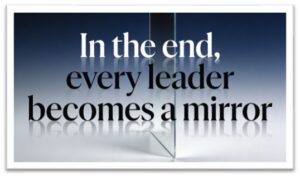
The people around us learn what leadership means by watching us. That is true whether we intend it or not.
So the real question is not whether people are watching.
They are.
The real question is: What are they learning from what they see?
And that is the invitation in front of all of us now.
Let this be the season we return to the fundamentals that never fail. Let this be the month we close the gap between our intentions and our example. Let this be the moment we stop asking slogans to carry the weight that only character can carry. Let this be the time we choose the quiet, durable strength of doing our job so faithfully, so clearly, and so consistently that the people around us are inspired to do the same.
Because in every generation, including this one, the leaders people trust most are the ones who give them something real to follow.